
Live Stream vs Recorded Webinar for Events

A webinar can be the centerpiece of a product launch, a leadership message, a training program, or a conference agenda. The choice between a live stream vs recorded webinar shapes more than the viewing experience. It affects how your audience participates, how your team prepares, what can go wrong, and how long the content continues working for your business after the event ends.
For organizations that care about brand presentation, the right answer is rarely based on convenience alone. It comes down to the purpose of the message, the audience's expectations, and the level of production support available.
Live Stream vs Recorded Webinar: The Core Difference
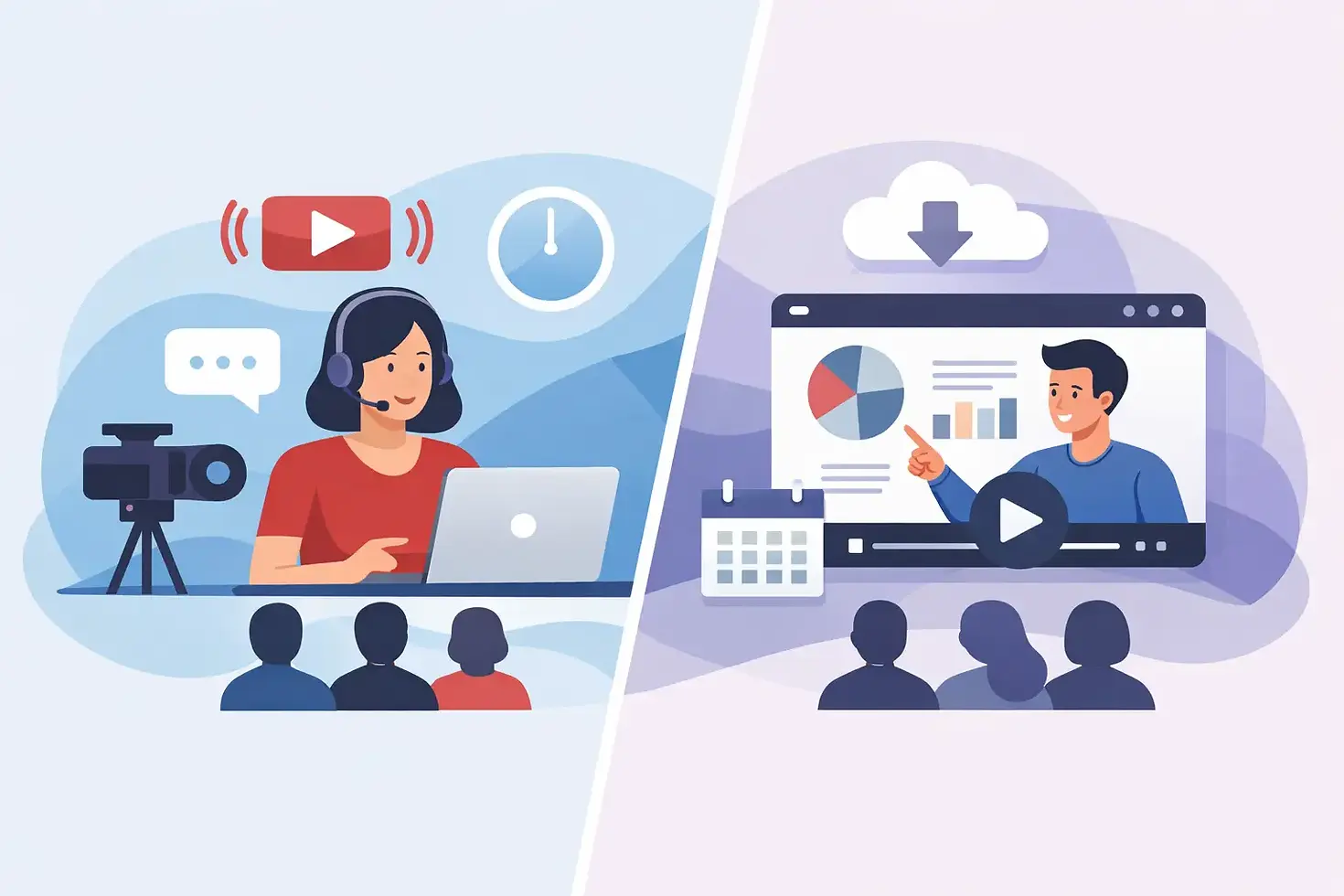
A live-streamed webinar happens in real time. Viewers tune in at a scheduled date and time, often with opportunities to submit questions, respond to polls, or participate in moderated discussion. It creates a shared moment, which can make an announcement, panel, or customer conversation feel timely and relevant.
A recorded webinar is produced before its release. It may be published on demand, scheduled to premiere at a specific time, or incorporated into an email campaign, learning portal, or sales process. Because the content is completed before viewers see it, the production team has more control over pacing, edits, graphics, audio, and overall presentation.
Neither format is automatically better. A live stream creates immediacy. A recorded webinar creates consistency and flexibility. The stronger choice is the one that supports the outcome your organization needs.
When a Live Webinar Makes Sense
Live webinars work especially well when the value depends on participation. If your company is hosting a thought-leadership discussion, revealing news that requires timely attention, or bringing experts together for a panel, the real-time element can add energy and credibility.
For event planners, a live webinar can extend the reach of an in-person program. Remote attendees can watch keynote sessions, participate in selected discussions, and feel included in an event they could not attend physically. For internal communications teams, a live town hall gives employees a direct channel to hear from leadership and ask questions in the moment.
The strongest advantage is interaction. A skilled moderator can use audience questions, polls, and comments to make viewers active participants rather than passive observers. That interaction also gives your business immediate insight into what the audience wants to know, where confusion exists, and which topics generate the most interest.
There is also a sense of occasion. People are more likely to make time for an event that happens once than for a video they assume they can watch later. A scheduled live session can support registration goals, create urgency, and give a campaign a clear focal point.
That said, live production carries real risk. An unstable connection, unclear audio, late speaker, failed screen share, or poorly managed Q&A can affect the audience's perception of the entire organization. The stakes rise when the webinar includes executives, clients, sponsors, or a large public audience. Professional planning matters because viewers often judge a brand by the quality of its communication, not by the difficulty of producing it.
When a Recorded Webinar Is the Better Choice
Recorded webinars are often the smarter option when accuracy, polish, and longevity matter most. A product demonstration, compliance training, evergreen educational session, or sales presentation may need to remain useful for months. Recording in advance gives your team the ability to refine the message before it reaches the audience.
This format is particularly valuable when multiple speakers are involved. Instead of hoping every presenter delivers a clean, confident segment in one take, the production can be recorded in sections. Pauses, stumbles, outdated references, and technical issues can be removed. Branded graphics, presentation slides, lower-thirds, captions, and supporting footage can be added with intention.
For marketing teams, that level of control protects brand standards. A recorded webinar can feel cohesive from the opening frame through the call to action. It also makes approval workflows easier. Legal, communications, leadership, and marketing stakeholders can review the content before distribution rather than responding after a live event has already happened.
Recorded content is also more accessible for busy audiences. A decision-maker who cannot attend a noon webinar may watch a 20-minute recorded session later that evening or share it with colleagues. When paired with a thoughtful distribution plan, one well-produced webinar can support lead nurturing, employee onboarding, social clips, email campaigns, and website content.
The trade-off is that recorded webinars can feel less immediate. Without a live Q&A or clear reason to watch now, some viewers may postpone the session indefinitely. The solution is not always to choose live production. It may be to build a stronger release strategy, such as a scheduled premiere, targeted invitations, or a follow-up discussion where viewers can bring questions.
Production Quality Changes the Decision
Many organizations choose between live and recorded formats based on budget or scheduling, then underestimate the production requirements. In reality, both formats benefit from careful preparation.
A live webinar requires dependable internet, tested audiovisual equipment, speaker preparation, backup plans, audience moderation, and a crew that can respond quickly when conditions change. Camera placement, lighting, sound, graphics, and screen-sharing workflows all contribute to whether the program feels professional or improvised.
A recorded webinar needs a different kind of discipline. The message must be planned around the intended viewer journey, not simply captured as a long presentation. Clean audio remains essential. Lighting must support a credible on-camera presence. Visuals should reinforce key points instead of competing for attention. Editing should improve clarity without making the content feel overproduced or impersonal.
For both options, the production approach should match the brand. A financial services firm may need a refined, controlled look with clear graphics and executive presence. A nonprofit may want a more conversational panel that highlights community voices. A technology company may prioritize sharp product screens, demonstrations, and concise expert commentary. The format is only one part of the decision. The execution determines whether the webinar earns trust.
Consider the Audience Before the Format
Audience behavior should guide planning. If attendees expect to ask questions, network, or hear timely updates, a live webinar is usually a better fit. If they need practical information they can access on their own schedule, recorded content may serve them better.
Consider where viewers are located, how much time they can realistically commit, and how familiar they are with the topic. A national audience across multiple time zones may appreciate on-demand access. A regional audience gathered around a major event may respond well to a live broadcast. For complex subject matter, a recorded session can let viewers pause, replay, and absorb details at their own pace.
It is also worth considering the relationship stage. Live webinars can create stronger connection with prospects who are already interested and ready to engage. Recorded webinars can efficiently introduce your expertise to a broader audience that is still evaluating their options.
A Hybrid Approach Often Delivers More Value
The choice does not have to be absolute. Many successful organizations use live and recorded content together. A live event can be professionally captured, edited, and repurposed into a polished on-demand webinar. A recorded presentation can premiere at a scheduled time, followed by a live Q&A with the speakers.
This hybrid approach provides the urgency of a live event while preserving the long-term value of a refined video asset. It also allows one production investment to support several business goals: event visibility, audience engagement, internal communications, marketing content, and future campaigns.
At Germain Gavonni Media, planning begins with the business objective behind the broadcast, not just the platform or camera setup. That perspective helps teams choose a format that protects their brand while giving the audience a reason to pay attention.
The best webinar is not the one with the most features or the largest audience on launch day. It is the one that communicates clearly, looks credible, and gives viewers a useful next step. Start with what your audience needs to do or understand after watching, then build the production around that moment.


Comments